
Noise-Induced Hearing Loss: What Every Employer Needs to Know

Noise-induced hearing loss (NIHL) is one of the most common and most preventable occupational health conditions in the UK. Yet it remains widely misunderstood, both by the employees affected and by the businesses responsible for protecting them. This post breaks down what NIHL is, why health surveillance matters, and what your legal obligations actually are.
It's written for employers, health and safety professionals, and anyone trying to make better sense of noise health surveillance.
What is noise-induced hearing loss?

NIHL is permanent hearing damage caused by excessive noise exposure at work. Inside the cochlea, the spiral-shaped part of the inner ear sit tiny hair cells that convert sound into nerve signals the brain can interpret. Excessive noise damages these cells, and crucially, they don't regenerate. Once they're gone, they're gone.
The result is reduced hearing, but it's not always as obvious as simply “everything sounds quieter.” People with NIHL often struggle to pick out certain consonants in speech, making conversation difficult even when the overall volume seems fine.
A few defining features of NIHL are worth keeping in mind:
• It's progressive. Damage usually builds over several years of exposure.
• It's preventable. With effective controls and early detection, it can be stopped from getting worse.
• It's permanent. There's no reversing the damage already done — which is exactly why catching it early matters so much.
Catching the warning signs early
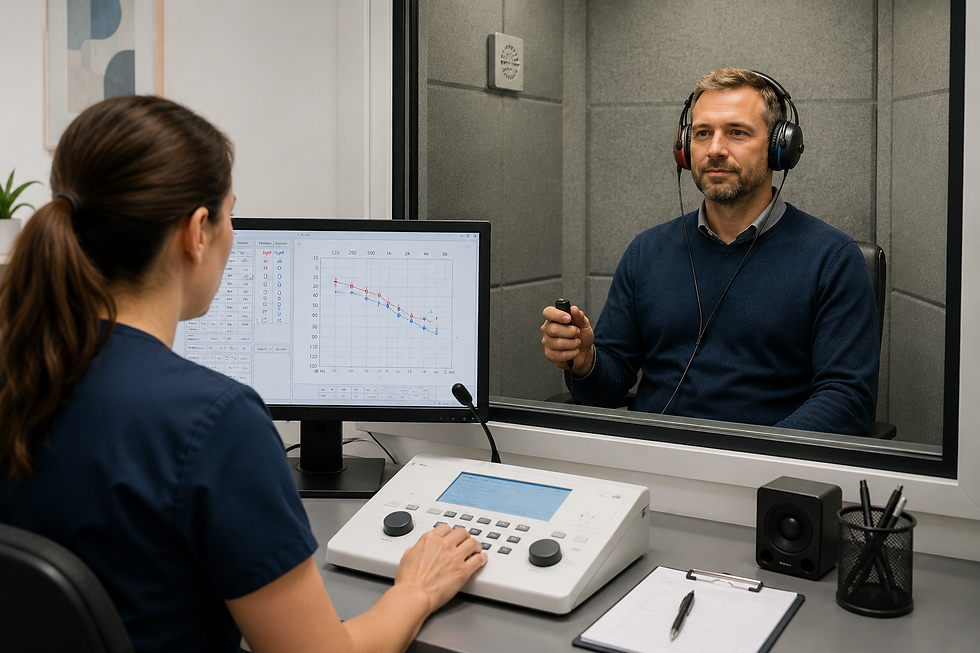
Since 2021, guidance on how audiograms are assessed and categorised has changed, with the goal of helping occupational health spot early patterns of noise damage and helping employers prioritise risk control.
The typical health surveillance process looks like this: the worker completes a noise health questionnaire covering previous noise exposure (both at work and outside it), medical history, and medications. Their ears are examined, a hearing assessment is carried out, and then the resulting audiogram is reviewed for signs suggestive of NIHL.
If those signs are present, the worker is placed in Category 3. The hearing test is usually repeated after one to three months, and if the signs persist, they're referred to an occupational health doctor.
Reading the audiogram: the notch

On an audiogram, frequency runs along the horizontal axis and hearing level (in decibels) runs down the vertical axis. Anything 20 dB or better (lower) is considered normal hearing.
From there:
• >20–40/50 dB indicates mild hearing loss
• 50–70 dB indicates moderate hearing loss
• Beyond 80 dB indicates severe or profound hearing loss
The classic signature of NIHL is a notch at 4 kHz, recommended by the Society of Occupational Medicine. Hearing reads as normal across most frequencies, dips sharply in the higher frequencies, then partially recovers at 8 kHz. That dip-and-recovery shape is the textbook picture of noise damage.
A notch isn't always noise
Workplace noise exposes both ears at similar levels, so genuine NIHL usually shows up symmetrically. A notch in one ear only could still be noise, but it could equally point to other causes such as certain medications, head injuries, or even tumours.
This is why any notch should trigger a referral to an occupational health doctor and a thorough medical history, to work out whether noise is really the culprit or whether something else is going on.
Who diagnoses NIHL?
An important point of clarity: occupational health doctors don't diagnose NIHL. Formal diagnosis comes from audiology or ENT specialists.
If NIHL is suspected, the route is usually a referral to the GP, or a suggestion that the employee visit a high-street provider such as Specsavers or Boots for a free hearing assessment, from where they can be referred onward to a specialist if needed.
Why GPs aren't the default pathway
It might seem natural to send an employee straight to their GP, but GPs generally aren't the right starting point for work-related hearing issues. They see an enormous range of conditions, but occupational causes aren't their specialty.
A GP typically won't be aware of the Control of Noise at Work Regulations, noise risk assessments, or workplace control measures, and with around 10 minutes per patient, there's limited room to dig into occupational detail.
On top of that, hearing surveillance isn't part of standard NHS work, so GPs can decline to get involved altogether.
Occupational health, by contrast, understands NIHL, has direct communication with employers, and can advise on controls. So when GP input is needed, it's best directed through occupational health rather than the employee bypassing OH entirely.
There are specific situations where GP involvement is appropriate, including:
• A large difference in hearing between the right and left ears
• Sudden hearing loss that appears out of nowhere
• Significant ear pain
• Dizziness or ringing sensations
• Any discharge from the ear
But for NIHL itself, occupational health should lead.
Why it matters in the workplace

Beyond the obvious harm to the individual, NIHL carries real consequences for the business.
Safety
Reduced hearing means a reduced ability to hear alarms, machinery, and instructions — which can directly contribute to errors and accidents. Where there's a concern, a functional assessment can help: a senior manager or health and safety lead observes the employee in the workplace to check they can hear and respond appropriately. It's rare for someone with NIHL to be completely restricted from a noisy environment; the aim is to confirm they can work safely and to keep reviewing the situation.
Disability and claims
If severe enough, NIHL can be considered a long-term disability affecting both work and personal life. It's also the second most common reason for employers' liability insurance claims, and some employees have pursued personal injury claims. Early intervention reduces that risk considerably.
The legal backdrop: Control of Noise at Work Regulations 2005

All of this sits within the Control of Noise at Work Regulations 2005, which govern both what occupational health does and what employers must do.
Two key thresholds, both based on average daily or weekly exposure (not a single instantaneous meter reading):
• At the lower exposure action value of 80 dB(A), employers must assess the risk, provide information and training, and make hearing protection available on request.
• At the upper exposure action value of 85 dB(A), hearing protection becomes mandatory and hearing protection zones must be established.
• There's also an exposure limit value of 87 dB(A) (taking into account the protection hearing protectors provide) above which workers must not be exposed.
Hearing surveillance is part of the employer's duty wherever there's a risk of hearing damage. So when an employee asks “Why am I here? I can hear fine, let me get back to work,” the answer is that surveillance is a legal obligation, not an optional extra.
How often should surveillance happen?

The standard approach is a baseline assessment when someone starts their employment. HSE's L108 guidance suggests audiometry annually for the first two years, then every three years thereafter, or more frequently if problems are identified.
That said, many employers opt for an annual check regardless: an approach worth recommending. A lot can change in a year: the tasks, the environment, and the employee's own health. Yearly testing helps detect subtle changes early, and the earlier a change is spotted, the sooner intervention can follow, whether that's advice on controls or an onward referral.
Annual surveillance also doubles as a check on whether existing control measures are actually working.
Controlling the risk

The hierarchy of controls applies here as it does everywhere: elimination first, engineering controls, administrative measures, and finally PPE as the last line of defence.
A noise survey: using a sound level meter or a personal dosimeter helps identify how loud the environment really is and which tasks are the noisiest, feeding directly into your risk assessment.
When employees are asked how noise is controlled at work, many jump straight to PPE. That's a signal to do two things: make sure PPE is being used correctly, checked for defects, and that staff are properly trained and use the moment to educate employees and identify whether better upstream controls are possible.
A note on early signs versus symptoms
One of the reasons NIHL is so insidious is that the signs appear before the symptoms. Many employees carry on working perfectly well with early signs of damage, unaware anything is wrong. Without intervention, though, the loss gradually worsens.
The whole point of regular surveillance is to catch those early signs, intervene, and review the noise risk assessment before the damage progresses. We can't bring dead hair cells back, but we can stop the loss getting worse.
Understanding the categories
The 2021 third edition of HSE's guidance (L108) revised how audiogram results are categorised, shifting the focus onto early signs of NIHL. Results fall into four categories, based on the presence or absence of NIHL together with the sum of hearing levels at 1, 2, 3, 4 and 6 kHz:
• Category 1 — hearing within the normal range for the person's age and sex
• Category 2 — mild hearing loss, or signs of NIHL (a notch/bulge) that have been stable
• Category 3 — newly identified or progressive NIHL (a notch or bulge that is new or getting worse) — and this applies regardless of whether the overall hearing levels reach the “significant hearing loss” threshold
• Category 4 — rapid hearing loss
Both Category 3 and Category 4 results trigger a referral to an occupational health physician
There's also a separate consideration for a large difference in hearing between the two ears, which prompts further investigation.
The HSE's role
The Health and Safety Executive (HSE) has the power to turn up at your premises at any reasonable time, without notice, to inspect whether you're complying with the regulations, particularly when following up on complaints or accidents. They can issue improvement notices or prohibition notices.
The reassuring flip side: if you follow the guidance on noise hearing surveillance and stick to the Control of Noise at Work Regulations, there's little reason an inspection should cause problems.
Key takeaways
• NIHL is preventable. Catch it early and you can stop it getting worse.
• Hearing surveillance is not optional. If your noise risk assessment deems it necessary, it must happen, and managers should actively encourage employees to attend their appointments.
• GPs aren't always the right pathway. Occupational health should lead on NIHL and advise on when GP involvement is appropriate.
• Follow the guidance. Do your noise risk assessment, provide protection and training, and review everything whenever the workplace, environment, tasks, or processes change.
And one simple test to finish on, echoing HSE's own rule of thumb: if your workplace is loud enough that you have to shout to be heard by someone about 2 metres away, exposure is likely around or above the action values, and it's a hazard. That's the cue to carry out a noise risk assessment — and to keep reviewing it.
Protect Your Workforce Today

Noise-induced hearing loss is preventable, but once the damage is done, it cannot be reversed. Regular health surveillance, effective noise controls, and timely occupational health referrals can help identify problems early and protect both your employees and your organisation.
If you'd like advice on noise health surveillance, occupational health referrals, or meeting your obligations under the Control of Noise at Work Regulations 2005, contact Insight Workplace Health today to see how we can help.
Sources for the legal and regulatory points in this post: HSE, Control of Noise at Work Regulations 2005 guidance (hse.gov.uk/noise) and L108 (3rd edition, 2021); Society of Occupational Medicine / UKHCA guidance on interpreting audiograms for occupational NIHL; GOV.UK occupational deafness (prescribed disease A10) claim guidance


Comments